The Reina Sofía building: from the Hospital de San Carlos to Nouvel
The Reina Sofía Museum is not a purpose-built art venue: it is an accumulation of historical layers that begins in the 18th century, when Madrid needed a great hospital, and reaches 2005, when the French architect Jean Nouvel completed his extension with one of the most audacious architectural interventions in contemporary Spain. To understand the building is to understand part of the history of Madrid.
Origins: the General Hospital of Madrid (18th century)
In the mid-18th century, Madrid lacked a great hospital befitting its status as an imperial capital. The city had inherited a cluster of medieval hospitals scattered across the urban fabric — the Hospital de la Latina, the Hospital de Antón Martín — that were both inadequate and insanitary. King Charles III, convinced that a great city needed great institutions, ordered the construction of a new hospital that would centralise the city's healthcare.
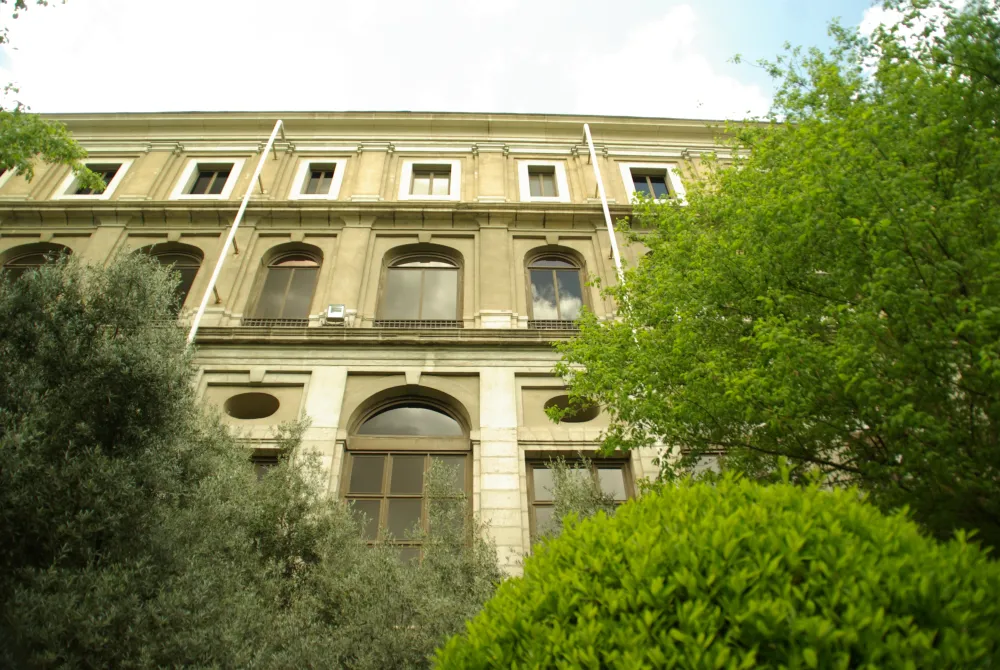
The project was initially entrusted to the architect José de Hermosilla, but it was Francesco Sabatini — Charles III's favourite architect, Italian-born but long settled in Spain — who developed and oversaw most of it. Sabatini was the same architect who had designed the Puerta de Alcalá and extended the Royal Palace, and his Neoclassical imprint is clearly visible in the building's facades today.
Construction began in 1758 and continued for decades, interrupted by financial difficulties and political upheaval. The building was never fully completed to the original design, which envisaged four regular facades around large inner courtyards. What was built was a section of the planned ensemble, though already of considerable dimensions: an entire city block in the Atocha neighbourhood, beside the Ronda de Atocha.
The Hospital de San Carlos: two centuries of medical life
Now known as the Hospital de San Carlos, the building functioned as Madrid's main reference hospital for nearly two centuries. It was the scene of crucial moments in Spanish history: during the Peninsular War it treated the wounded from the Napoleonic battles; throughout the 19th century it was a setting for medical and academic advances — some of the most important physicians in modern Spanish history worked there — and during the Civil War it served as a field hospital.
By the mid-20th century the building had become obsolete for the demands of modern medicine. In 1965 the hospital moved to new facilities at the Ciudad Universitaria and the old building was left empty, in an advanced state of deterioration.
Conversion into a museum and Ian Ritchie's towers (1990)
The decision to convert the former Hospital de San Carlos into a major museum of modern art was taken in the 1980s, in the context of the cultural transformation of democratic Spain. The building was rehabilitated by the architects Antonio Fernández Alba and, subsequently, the team led by José Luis Íñiguez de Onzoño and Antonio Vázquez de Castro, who adapted the interior spaces for museum use.
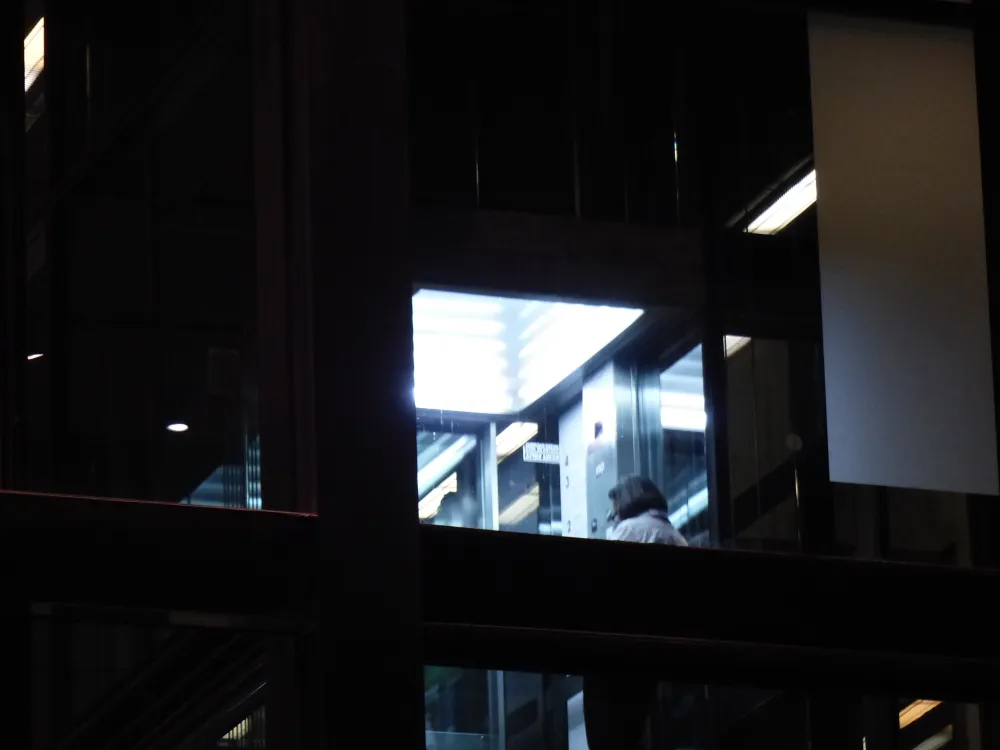
The most eye-catching element of this first phase was not, however, the interior rehabilitation but the two glazed lift towers attached to the building's facades, designed by the British architect Ian Ritchie. Inaugurated in 1990, together with the museum's opening, these towers are now one of the most recognisable features of the complex: lightweight steel-and-glass structures that deliberately contrast with the Neoclassical stonework of the Sabatini building and offer panoramic views over the rooftops of the Atocha neighbourhood.
Ritchie's intervention was controversial at the time — as almost any addition of contemporary architecture to a historic building tends to be — but has since come to be accepted as part of the museum's visual identity. The towers are not only functional: they are also a symbol of the building's change of purpose, its transformation from a place that healed bodies into one that houses art.
Jean Nouvel's extension (2005): the great red canopy
By the early 21st century, the Reina Sofía had outgrown the space available in the Sabatini building. Large-scale temporary exhibitions, growing collections and the services required by a world-class museum — restaurant, library, auditorium, shop — all needed more room. An international competition was held in 1999 and won by the French architect Jean Nouvel.
The extension opened in 2005 and brought about a radical transformation of the museum's appearance. Nouvel proposed not a single building but three new structures arranged around the rear courtyard of the Sabatini, connected to each other and to the original building by walkways and galleries. The ensemble houses Collection 2, the auditorium, the library and media library, education spaces and the museum restaurant.
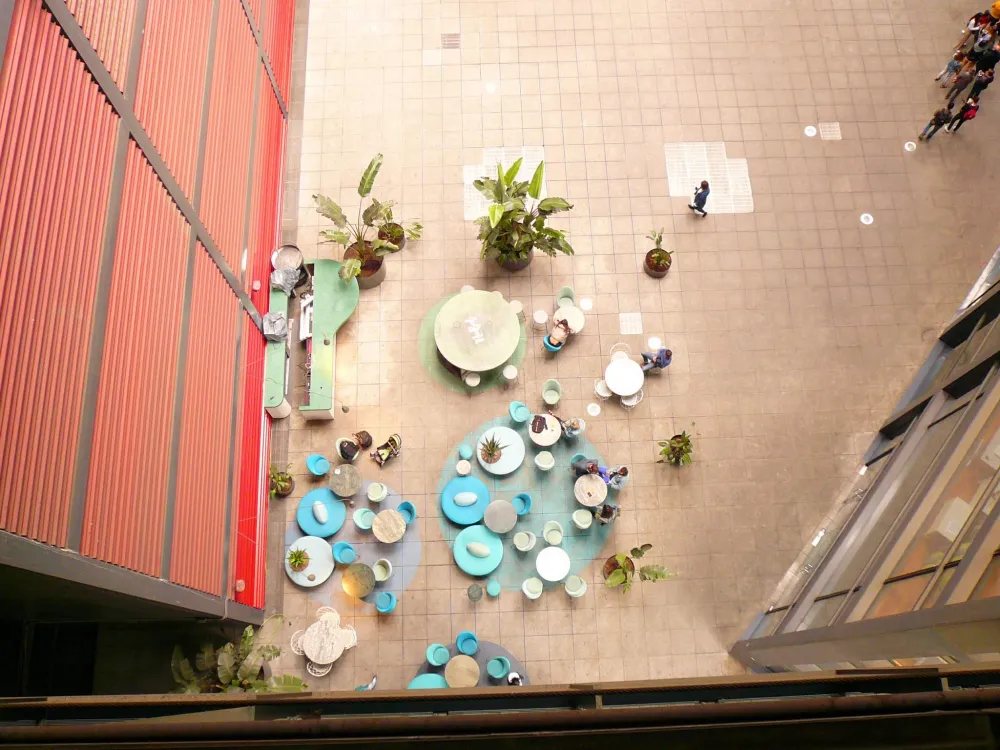
The most striking and recognisable element of the extension is the large red metal canopy — an intense, almost lacquered red of enamelled steel — that floats high above the central courtyard, creating a covered outdoor space on an urban scale. Beneath that canopy, the courtyard becomes a transitional space between the city outside and the museum within: a covered public space, sheltered from sun and rain, which can be used for events, installations and simply for sitting.
The dialogue between the historical and the contemporary
The most interesting thing about the current Reina Sofía complex is precisely the tension between its different temporal layers. The Sabatini building, with its grey stone and severe Neoclassical articulation, coexists with Ritchie's glass towers and Nouvel's red steel. There is no desire for homogeneity: each intervention speaks its own language and marks its own era.
This accumulation is, in a sense, a reflection of the collection it houses: 20th-century art is also a continuous conversation between tradition and rupture, inheritance and avant-garde. The building is, in that respect, coherent with its contents.
| Original building | Hospital General de San Carlos, begun 1758 |
|---|---|
| Original architects | Francesco Sabatini and José de Hermosilla |
| Lift towers | Ian Ritchie, 1990 (museum opening) |
| Extension | Jean Nouvel, inaugurated 2005 |
| Canopy | Red enamelled steel over the central courtyard |
| Address | C/ Santa Isabel 52, Madrid (next to Atocha) |
Discover the building from the inside
A guided tour of the Reina Sofía also brings the architecture to life: the rooms of the Sabatini building, Nouvel's courtyard and the spaces that connect history with the contemporary.
See guided tours →⏳ Time-slot places are limited. Lock in your time · guided tour cancels free up to 24 h before.
Frequently asked questions about the building
What was the Reina Sofía building before?
The General Hospital of Madrid, also known as the Hospital de San Carlos. It was built in the 18th century during the reign of Charles III and designed mainly by Francesco Sabatini.
Who designed the Reina Sofía extension?
The French architect Jean Nouvel. His extension, inaugurated in 2005, added three new buildings connected by a large red metal canopy over the central courtyard.
What are the glass towers of the Reina Sofía?
Two glazed towers housing the panoramic lifts, designed by the architect Ian Ritchie and inaugurated in 1990 together with the museum's opening.
How many buildings does the Reina Sofía have?
The complex comprises the Sabatini building (18th century) and the three buildings of Jean Nouvel's extension (2005), all connected to one another.
Content reviewed by the Ticket Visit team · June 2026.